
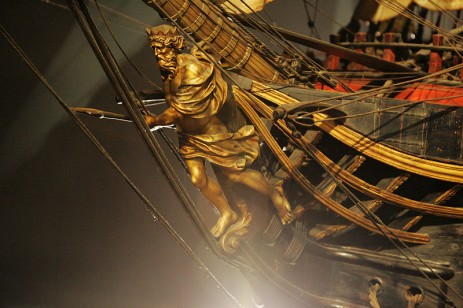
Of late, I have been fascinated with nautical figureheads (like the one on the model of the 1790 French frigate Océan, pictured above). These wooden carvings on the prows of early sailing ships did not only serve to identify the vessel. They held a symbolic significance for the crew and were often associated with the spiritual world. Alas, such artistic expressions belong to the distant past.
Today’s ships are like floating banner advertisements. They usually have the name of the company emblazoned on the hull with the vessel’s name painted near the bow (as seen on the container ship MSC Oscar pictured below). On the stern might be displayed the International Maritime Organization (IMO) number—just as canned goods in the supermarket would sport a product code.

Aesthetics in shipping isn’t dead, of course. Some modern vessels can be as pretty as Ferraris. But they look stodgy compared with the majestic sailing ships that spurred Dutch Golden Age painter Hendrik Cornelisz Vroom to paint in 1630 “The Harbour in Amsterdam” (pictured below).

It wasn’t just the owners and builders of frigates and galleons who seemed to embody the artistic spirit. Sailor tattoos (depicted below by American maritime artist-blogger coldisthesea) enabled yesterday’s mariners to express themselves. It was symbolic art on a very personal level and an affirmation of the individual’s special affinity with the sea.

Has contemporary shipping become too obsessed with efficiency and profit that it is killing its desire for art? Given the scant attention the industry and the maritime press is giving maritime art, this, sadly, may be the case.
PHOTO CREDITS:
1) Océan frigate model: Photo by Rama, Wikimedia Commons, Cc-by-sa-2.0-fr
2) MSC Oscar containership: Photo by Rolf Heinrich


BU – good point! And not just applicable to our seagoing world. It’s the same process Charlie Chaplin hilariously exploited in ‘Modern Times’ almost 80 years ago.
Human beings have shrunk & dwindled in the modern world in many ways, and I can certainly testify that this has taken place in maritime. My seagoing life began in the 1960s and only ended ten years ago when I swallowed the anchor and came into the office; but even in that short span of 40 years I’ve seen men increasingly dwarfed by the technology and the machinery of modern marine transport.
Even navigation – an important and man-intensive endeavor just 40 years ago – has become automated. We hear of daylight accidents, in good visibility, taking place because the Mate has his head in a computer: either immersed in the virtual navigational world of his ECDIS, or catching up on paperwork while the computer drives the ship.
Port stays are often just a purgatory of cargo duty on no sleep – my sailor friends don’t get ashore much anymore. One guy said: “See the world? All I see is the ship!”
There isn’t as much humanity in the human element as there used to be!
By the way – haven’t visited lately, nice bright new look to your site! Very nice.
A pleasure to have you visit again, Reid. Thanks very much indeed.
You are so right. Technology can be a despot, and it seems to have overwhelmed the art of navigation.
As for our website makeover, the biggest change is that it is now mobile-friendly. Even bloggers have to surrender to technology. 🙂